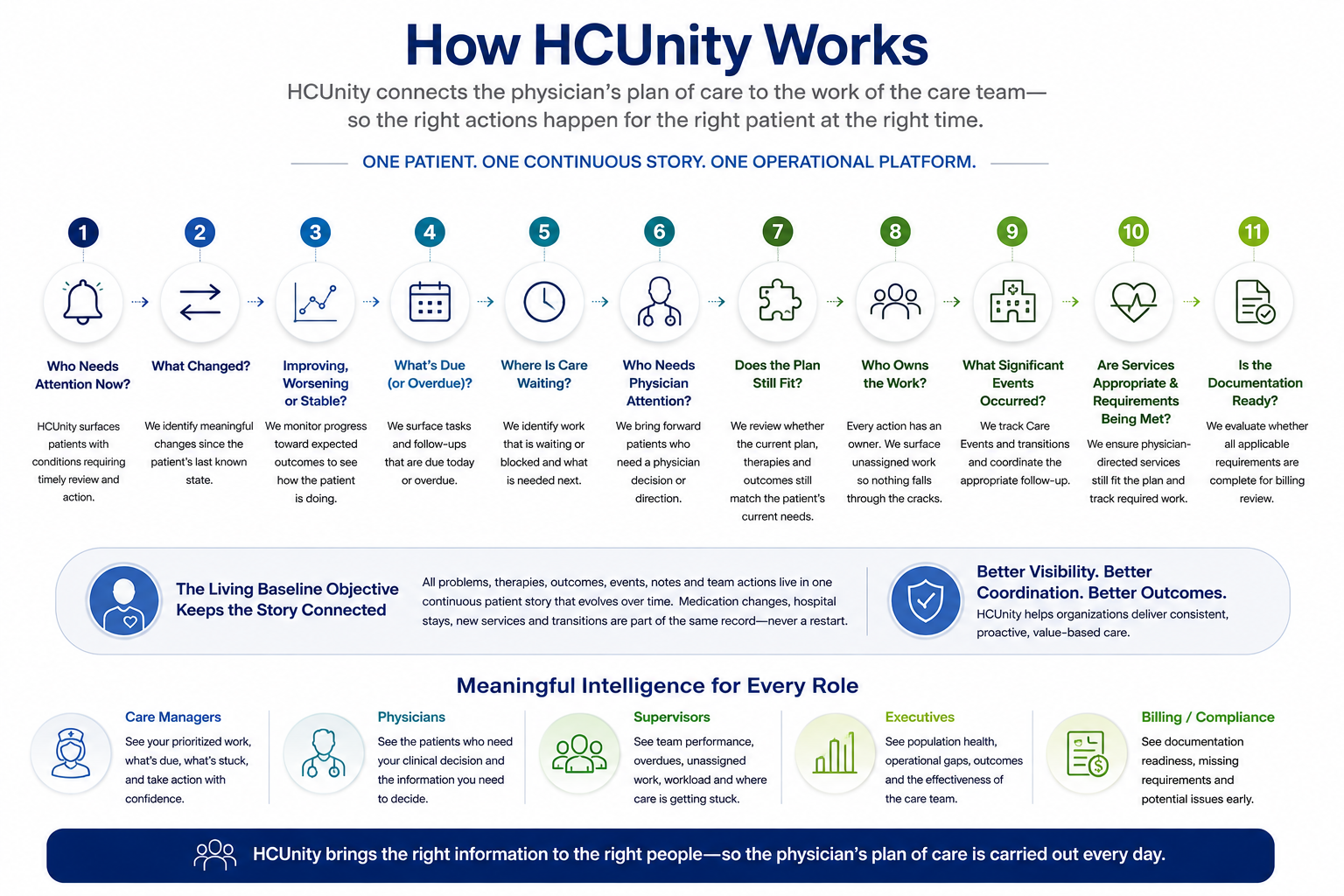
How HCUnity Works
Why Organizations Need HCUnity
Patients move through many different care management activities over time.
A patient may begin with a physician referral, participate in Remote Patient Monitoring (RPM), require Chronic Care Management (CCM), experience a hospital discharge requiring Transitional Care Management (TCM), or need ongoing Advanced Primary Care Management (APCM) support.
As these activities grow, organizations often struggle with:
• disconnected workflows
• limited visibility
• missed follow-up opportunities
• fragmented patient oversight
• difficulty maintaining continuity
• uncertainty about which patients need attention
HCUnity helps organizations bring these activities together within one connected operational care management structure designed to improve visibility, coordination, and continuity over time.
One Simple Goal
HCUnity helps organizations answer an important operational question:
"Which patients, workflows, or activities need attention right now, and what happened previously that we should know about?"
By helping organizations improve visibility, coordination, and continuity, HCUnity supports a more connected approach to operational care management.
One Connected Operational Care Management Structure
Healthcare organizations often manage RPM, CCM, TCM, APCM, and other patient oversight activities through separate workflows, teams, and systems.
As patient needs change, maintaining continuity, coordination, and visibility becomes increasingly difficult.
HCUnity helps organizations bring these activities together within one connected operational care management structure designed to support patient oversight over time.
Rather than creating additional operational silos, HCUnity helps organizations keep patient oversight, workflow coordination, and follow-up activities connected throughout the patient journey.
Understanding APCM
Advanced Primary Care Management (APCM) is designed to help healthcare providers stay connected with patients between office visits.
Instead of only caring for patients during scheduled appointments, APCM supports ongoing coordination, communication, follow-up, and care planning throughout the month.
The goal is to help patients receive more consistent support while helping providers maintain continuity of care.
What Happens Each Month?
Throughout the month, care teams may:
• coordinate care activities
• communicate with patients and caregivers
• support physician-directed care plans
• assist with transitions of care
• help patients remain engaged in their healthcare
• coordinate with specialists and community resources
APCM helps support continuity between visits so patient care remains connected over time.
APCM and Value-Based Care
APCM and Value-Based Care share many of the same goals.
APCM Focuses On:
• patient management
• care coordination
• communication
• continuity
• ongoing support
Simple question APCM answers: "How are we supporting this patient this month?"
Value-Based Care Focuses On:
• outcomes
• quality
• patient health
• cost management
• long-term performance
Simple question Value-Based Care answers: "Are patients doing better over time?"
The Simple Difference
APCM helps providers manage patients.
Value-Based Care measures the results.
Step 1 — Patient Enters the System
Patients may enter through:
• physician referrals
• hospital discharges
• APCM enrollment activities
• RPM programs
• CCM programs
• TCM transitions
• existing care management workflows
HCUnity helps organizations organize intake, oversight activities, and workflow coordination from the beginning of the patient journey.
Step 2 — Identify What Needs Attention
One of the biggest challenges in care management is knowing which patients need attention and which activities require follow-up.
HCUnity helps organizations improve visibility into:
• patients requiring follow-up
• unresolved oversight activities
• transition-related needs
• workflow coordination opportunities
• engagement concerns
• continuity gaps
This helps teams spend less time searching for information and more time supporting patients.
Step 3 — Support Connected Care Management Activities
HCUnity helps organizations support operational activities commonly associated with:
RPM
Physician-directed monitoring activities when ongoing monitoring is medically appropriate.
CCM
Ongoing chronic care coordination and patient engagement activities.
TCM
Follow-up and coordination activities during transitions of care.
APCM
Longitudinal patient oversight and coordination activities supporting continuity over time.
These activities remain connected within one operational structure instead of functioning as isolated workflows.
Step 4 — Help Teams Focus on What Matters
Care teams often manage hundreds or thousands of patients across multiple services and workflows.
HCUnity helps organizations surface operational attention needs that may otherwise be difficult to identify.
This may include:
• patients needing follow-up
• unresolved workflow activities
• transition coordination opportunities
• engagement concerns
• continuity review opportunities
• operational exceptions
This helps teams focus attention where it may have the greatest impact.
Step 5 — Governance & Oversight Support
HCUnity supports governance-focused operational workflows designed to help organizations maintain visibility into:
• appropriateness review opportunities
• workflow completion activities
• operational exceptions
• continuity across transitions
• oversight coordination needs
• longitudinal documentation activities
Governance operates quietly underneath daily operations while helping organizations maintain greater visibility and consistency across care management activities.
Step 6 — Work With Existing Systems
Organizations do not need to replace existing infrastructure.
HCUnity is designed to work alongside:
• existing EHRs
• existing vendors
• existing workflows
• interoperability infrastructures
• care management operations
Organizations remain in control of their clinical, billing, and operational decisions while HCUnity helps provide the operational structure supporting connected patient oversight.
Step 7 — Maintain Continuity Over Time
Patient needs change.
Services change.
Care management activities change.
HCUnity helps organizations maintain continuity by helping patient oversight, workflow coordination, follow-up activities, and operational visibility remain connected over time as patient needs evolve.
Baseline Oversight & Care Coordination
HCUnity helps organizations establish a more connected view of the patient through:
-
physician-aligned care coordination
-
baseline oversight activities
-
patient engagement workflows
-
longitudinal documentation support
-
operational visibility into patient needs
This helps organizations maintain continuity as care needs evolve over time.
Connected Operational Care Activities
HCUnity helps organizations support operational care management activities including:
RPM
Physician-directed monitoring activities when medically appropriate.
CCM
Ongoing chronic care coordination and patient engagement.
TCM
Follow-up and coordination during care transitions.
APCM
Continuous patient oversight and longitudinal care coordination.
These activities work together within one connected oversight structure rather than isolated workflows.
Operational Intelligence & Visibility
HCUnity helps organizations improve visibility into:
-
patient oversight activities
-
workflow coordination
-
unresolved follow-up needs
-
transition activities
-
continuity gaps
-
engagement trends
-
longitudinal patient oversight
This helps care teams maintain a more connected operational view across the patient journey.
Governance & Oversight Support
HCUnity supports governance-focused operational workflows designed to help organizations maintain visibility into:
-
appropriateness of activities
-
workflow completion
-
operational exceptions
-
continuity across transitions
-
patient oversight coordination
-
longitudinal documentation support
Integration & Interoperability
HCUnity is designed to work alongside existing:
-
EHRs
-
vendors
-
operational workflows
-
interoperability infrastructures
-
care management operations
Organizations remain in control of their clinical, billing, and operational decisions while HCUnity helps provide the operational structure supporting connected oversight activities.
Continuity Over Time
HCUnity helps organizations support continuity by helping patient oversight, coordination, follow-up, and operational visibility remain connected over time as patient needs evolve.